


Nayyi Navelli Movie Review: Yami Gautam Shines in a Fantasy-Horror Comedy That Loses Its Way After the Interval
Amanopedia Movie Review | Rating: 2.5/5
Cast: Yami Gautam, Aditya Kulshreshth, Anurag Thakur, Sunita Rajwar, Adinath M. Kothare, Prateek Pachori, Meeta Vashisht, Sonal Jha and Sushmita Mukherjee
Director: Balaji Mohan
Genre: Hindi, Horror, Comedy, Fantasy
Runtime: 2 hours 18 minutes
Theatrical Release: October 16, 2026
Introduction: An Unusual Fantasy with Promising Ideas
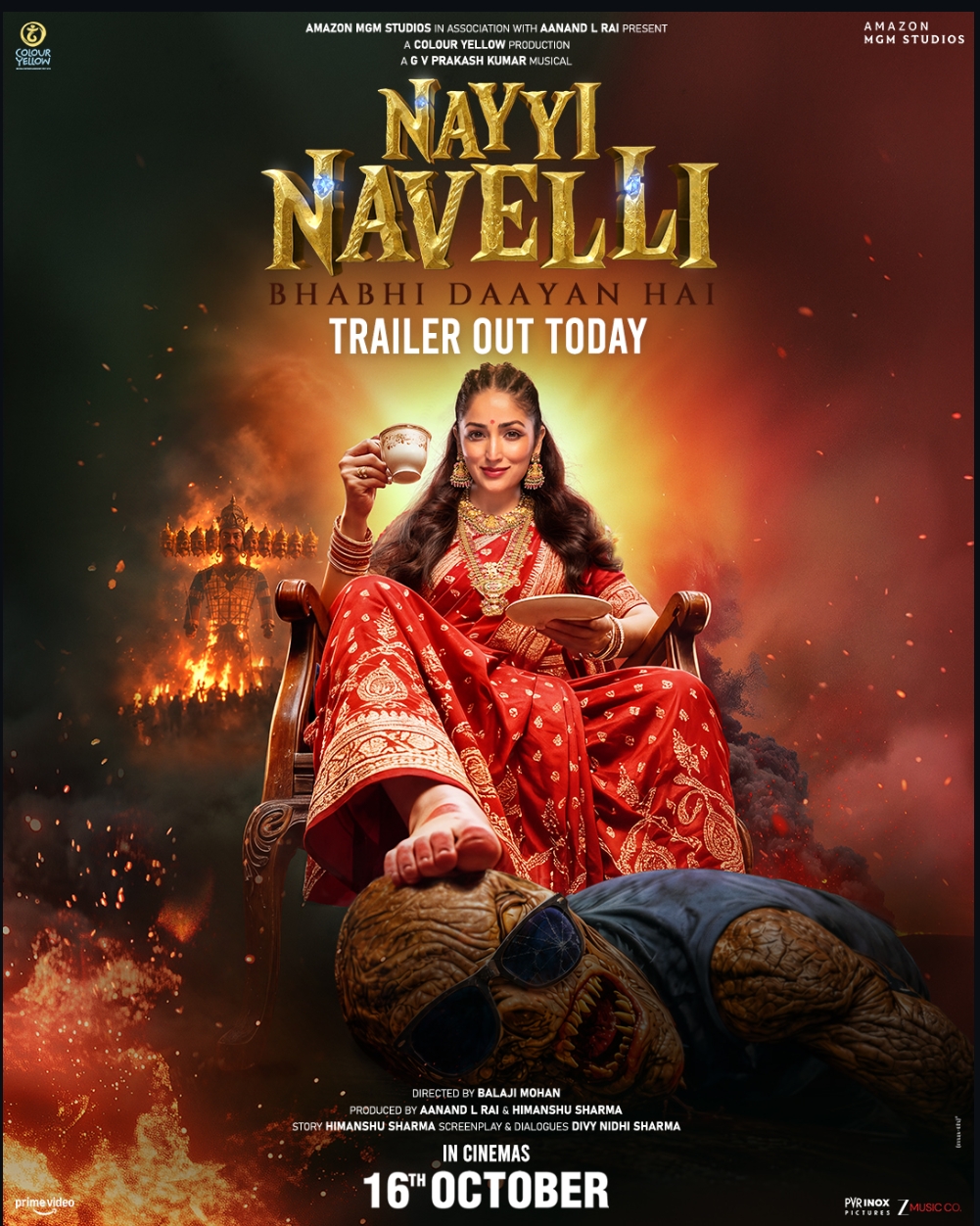
What happens when horror, comedy, mystery and Hindu mythology come together in one fictional universe? Nayyi Navelli attempts to answer that question with an unconventional story that blends supernatural elements, family drama and mythological references.
With a creative vision associated with filmmaker-producer Anand L. Rai and direction by Balaji Mohan, the film attempts to build a fantasy world that moves far beyond everyday reality. The narrative revolves around a family from Meerut and gradually connects its circumstances to the era of the Ramayana.
The premise offers considerable possibilities for an entertaining cinematic experience. However, while the film begins with an intriguing mix of horror and comedy, its storytelling becomes increasingly complicated as it progresses. Yami Gautam holds the screen with a confident performance, and several supporting actors provide genuine moments of laughter, but the screenplay struggles to maintain consistency.
The result is a film with entertaining ingredients and an ambitious concept, yet one that fails to bring all its ideas together convincingly.
Story and Screenplay: An Interesting Beginning, an Unfocused Second Half
Nayyi Navelli introduces viewers to a fictional world where supernatural powers, family relationships and mythological connections coexist. The story follows a family in Meerut whose circumstances gradually become linked to the Ramayana period, taking the narrative in an unexpected direction.
The first half establishes the horror-comedy atmosphere reasonably well. The mystery surrounding the central female character, her celestial powers and the unusual situations involving the family creates curiosity. The humour arising from family interactions also helps the film maintain a relatively entertaining rhythm.
Unfortunately, the screenplay begins to lose its grip after the interval.
The film attempts to expand its supernatural universe by introducing major mythological figures and conflicts involving Ram and Ravan. This shift could have provided a powerful dramatic payoff, but the transition feels abrupt and insufficiently developed. The original horror-comedy premise gradually gets overshadowed by a more complicated mythological narrative.
Despite a runtime of approximately 2 hours and 18 minutes, the storytelling feels stretched in places. The problem is not simply the duration; it is the way the narrative handles its many ideas. Several connections are amusing, while others feel forced and fail to create the desired emotional or dramatic impact.
A stronger screenplay, tighter editing and a more gradual transition between fantasy, comedy and mythology could have significantly improved the film.
Yami Gautam: The Film’s Biggest Strength
Yami Gautam delivers one of the film’s most engaging performances. Playing a woman with celestial powers, she brings confidence, screen presence and a sense of mystery to a character that requires her to move between fantasy, humour and dramatic situations.
Her performance helps establish the film’s unusual atmosphere, and she remains watchable even when the narrative becomes confusing. She understands the character’s fantastical nature and gives it a distinct personality rather than allowing it to become merely a collection of supernatural gestures.
Yami’s presence is one of the primary reasons the film remains engaging despite its narrative shortcomings.
Aditya Kulshreshth: A Character That Deserved More
Aditya Kulshreshth plays Raja, Mohini’s husband. Although the character has the potential to contribute substantially to the family drama and comedy, the writing does not give him enough consistent material to make a strong impact.
His character often feels underdeveloped, with limited opportunities to establish a memorable personality. As the story progresses, the performance is held back by a script that does not fully utilise the character’s potential.
Even when the narrative introduces more dramatic situations, Raja fails to receive the kind of well-written moments that could have made him a stronger presence in the film.
Anurag Thakur as Bantu: A Welcome Dose of Comedy
Anurag Thakur, playing Bantu, emerges as a notable source of entertainment. His comic timing, expressive face, body language and reactions bring energy to several scenes.
The playful exchanges between Mohini and her brother-in-law Bantu provide some of the film’s more enjoyable moments. Their interactions create a lively family atmosphere and offer relief from the increasingly complicated storyline.
Bantu’s character benefits from physical comedy and expressive performance, making these sequences more effective than several of the film’s heavier dramatic passages.
Supporting Cast: Experienced Performers Make Their Presence Felt
The supporting cast adds considerable value, even when individual characters receive limited screen time.
Sunita Rajwar, Meeta Vashisht and Sushmita Mukherjee make the most of their respective roles. Meeta Vashisht, playing the aunt, and Sushmita Mukherjee, playing the grandmother, contribute humour and personality to the family dynamics.
Their performances help the film retain its comic appeal, particularly during scenes where the screenplay relies on family banter and character-driven humour.
Adinath M. Kothare, Prateek Pachori, Sonal Jha and the other supporting performers contribute to the film’s ensemble. Overall, the acting remains one of its more consistent aspects, even though not every character receives enough development.
Mythology and Fantasy: An Ambitious Idea That Needs Greater Care
One of the film’s most distinctive choices is its attempt to connect a contemporary fictional family with the world of the Ramayana.
The idea of combining Hindu mythology with an entirely fictional supernatural universe offers creative possibilities. However, such an approach requires careful world-building, clarity of purpose and a strong understanding of the emotional significance attached to mythological characters and symbols.
In Nayyi Navelli, some of these connections feel more like unexpected plot devices than naturally developed parts of the story.
The portrayal of mythological confrontations, including the treatment of Lord Shiva’s trident and Lord Hanuman’s gada in relation to Ravan, may also leave some viewers uncomfortable. These symbols carry deep cultural and religious significance, and the film’s treatment of them does not always create the sense of dignity or dramatic weight that the moments demand.
Fantasy cinema is free to reinterpret familiar stories, but its creative choices work best when they are supported by convincing writing and a coherent narrative framework. Here, the film’s mythological ambitions ultimately exceed the strength of its screenplay.
Direction: A Bold Concept Without Enough Narrative Control
Director Balaji Mohan attempts to combine several genres within a single film. The horror-comedy setup, supernatural mystery, family interactions and mythological drama each offer different possibilities for entertainment.
The challenge lies in making these elements feel like parts of the same story.
The first half demonstrates the potential of the concept, but the second half struggles to maintain a clear direction. The transition from light-hearted supernatural comedy to a larger Ramayana-inspired conflict lacks the dramatic build-up needed to make the change convincing.
The film could have benefited from a more focused narrative approach, better-developed character motivations and a clearer balance between comedy and mythology.
Action, Background Score and Songs
The action sequences bring energy to the film, with fight scenes that have a reasonable sense of impact. These moments provide a welcome change of pace when the narrative becomes overly dependent on exposition and mythological references.
The background score supports the film’s suspenseful and fantastical atmosphere. It helps establish tension in the supernatural sequences and adds intensity to the action.
The songs are reasonably entertaining, with tracks such as “Fata Patakha” and “Bhabhi Tabahi” adding to the film’s playful mood. However, the music does not consistently leave a lasting impression once the film ends.
The technical elements support the entertainment quotient, but they cannot entirely compensate for the screenplay’s structural weaknesses.
Message and Overall Impact
Beneath its fantasy, humour and supernatural conflicts, Nayyi Navelli attempts to communicate a message about human behaviour, the struggle between good and evil, and the values associated with Lord Ram’s lineage.
These ideas offer the film an opportunity to move beyond spectacle and create a more meaningful emotional experience. Some of the intended lessons are worthwhile, but their impact is reduced by the uneven storytelling and the film’s increasingly complicated second half.
The climax is particularly disappointing because it does not deliver the satisfying resolution that the premise promises. Instead of bringing its various narrative threads together with clarity, the film ends up feeling like an underdeveloped adaptation of mythological themes within a modern fantasy setting.
Final Verdict: Worth Watching for Yami Gautam, but with Reservations
Nayyi Navelli has several ingredients that could have made it a distinctive horror-comedy: Yami Gautam’s screen presence, entertaining family interactions, a capable supporting cast, energetic action and an unconventional fantasy concept.
However, the film’s weak screenplay and abrupt shift in direction after the interval prevent it from reaching its full potential. The comedy works in patches, the mythology feels unevenly integrated, and the climax fails to deliver a satisfying conclusion.
The film is not without its entertaining moments, but its ambitious concept needed stronger writing, a tighter edit and a more carefully developed second half.
Amanopedia Verdict: Nayyi Navelli is a mixed bag that offers moments of laughter and a strong performance from Yami Gautam, but its confusing narrative prevents it from becoming a memorable fantasy entertainer.
Rating: 2.5/5
Review by: Aman Deep Walia | Amanopedia News
Nayyi Navelli Review: Yami Gautam Shines, Weak Story Disappoints
Nayyi Navelli movie review: Yami Gautam impresses in this fantasy horror-comedy, but a weak screenplay and confusing second half disappoint. Read Amanopedia’s verdict and rating.
nayyi-navelli-movie-review-yami-gautam
Nayyi Navelli Review: Yami Gautam Impresses, but the Film Loses Its Way After the Interval
Nayyi Navelli Movie Review: An Interesting Fantasy Idea Let Down by a Weak Screenplay
Yami Gautam Shines in Nayyi Navelli, but Does This Horror-Comedy Deliver?
Nayyi Navelli Review: Laughter, Mythology and Mystery in a Fantasy Film That Falls Short
Nayyi Navelli Review: Laughter, Mythology and Mystery in a Fantasy Film That Falls Short
Nayyi Navelli First Review: Strong Performances, Confusing Story and a Disappointing Climax
Q1. Is Nayyi Navelli worth watching?
Nayyi Navelli may appeal to viewers who enjoy fantasy, horror-comedy and unusual mythological concepts. Yami Gautam and the supporting cast offer entertaining moments, although the weak second half may disappoint some viewers.
Q2. Who is the lead actress in Nayyi Navelli?
Yami Gautam plays the central female character, portrayed as a woman with celestial powers.
Q3. Who directed Nayyi Navelli?
The film is directed by Balaji Mohan.
Q4. What is the genre of Nayyi Navelli?
It combines Hindi-language horror, comedy and fantasy, with elements inspired by Hindu mythology.
Q5. What is the runtime of Nayyi Navelli?
The supplied film details list its runtime as approximately 2 hours and 18 minutes.
Q6. What is the rating of Nayyi Navelli by Amanopedia?
Amanopedia’s review rating is 2.5 out of 5 stars, recognising the performances and humour while noting the screenplay’s weaknesses.
Q7. What is the biggest drawback of Nayyi Navelli?
The main drawback is its uneven screenplay. The story begins as a supernatural horror-comedy but shifts into a more complicated mythological conflict after the interval, weakening the narrative and climax.
Review highlights
-
Yami Gautam delivers a confident, engaging performance.
-
Anurag Thakur’s comic timing and expressions add humour.
-
Sunita Rajwar, Meeta Vashisht and Sushmita Mukherjee make the most of their roles.
-
The action sequences and background score provide energy.
-
The film’s fantasy concept has potential but lacks consistent execution.
-
The second half becomes confusing and less engaging.
-
The climax fails to provide a satisfying payoff.

Author: Aman Deep Walia
Aman Deep Walia Founder/Editor-In-Chief Amanopedia News Aman Deep Walia, also known as Aadi, is an Indian media entrepreneur, actor, producer, writer, and director based in Mumbai, India. As the Founder and Editor-in-Chief of AMANOPEDIA News, he leads a fast-growing digital entertainment platform delivering verified industry updates, celebrity features, and cultural commentary across web and social media. With creative credits spanning films, theatre, and advertising. Aman brings a multidisciplinary perspective to storytelling. His work reflects a commitment to authenticity, versatility, and audience-driven narratives across genres. Beyond performance and production, he is actively engaged as a journalist and digital content creator, bridging mainstream cinema with emerging media formats. He has also contributed as a casting director and lyricist, further expanding his creative footprint within the Indian entertainment landscape. Through AMANOPEDIA, Aman Deep Walia continues to position himself at the intersection of journalism, cinema, and digital innovation.